
When December arrives, I begin to think Christmas thoughts. This leads to memories of hot chocolate, eggnog, mulled cider, and all the goodies that go with them.
My childhood memories of Christmas always include the German holiday bread called Stollen. Early in her marriage, my mother learned to make this traditional confection to please my German father. Every year, it appeared at our table throughout December.
We children did not care much for Stollen. Left out on the counter so our father could take a piece at will, it was always so dry it had to be washed down with something. But that was how he liked it . . . dry and hard around the edges. “Perfect with a cup of coffee,” he would say. My sister and I would have preferred a moist cake without those chewy nuggets of candied citron, a traditional ingredient in Stollen.
Despite all this, I love the idea of Stollen. I remember as a child, when the bread-like cake was left to rise and my mother wasn’t looking, I would pinch a taste of the raw dough with its hint of sweetness, yeast, and almond extract. The pleasant, yeasty aroma of the baking Stollen mingles with my memories of the holiday smells of pine needles, candle wax, and cinnamon. If I was lucky enough to get a warm slice just out of the oven, topped with a dab of melting butter and with the nasty citron picked out, I was in heaven.
In my two novels, based on the true stories of my family in Germany, Britain, and the United States during World War II, Stollen makes three appearances.
From Ashes and Ruins:
December 25, 1935, Germany
Christmas dinner was a sad gathering with only Mutti, Herman, and me seated at the dining table. We nibbled on goose wings, red cabbage, and potatoes. We asked Cook to join us for dessert, and she emerged from the kitchen carrying a frosted stollen on Mutti’s crystal platter. The sweet cake, redolent with spices, nuggets of dried fruits and nuts dotting each slice, cheered us up. The yeasty taste reminded me of past holidays. I told the story of finding coal in my stocking when I was ten and later, a new doll under the Christmas tree. This year, there is no decorated tree in the parlor, yet Herman insisted we sing “O Tannenbaum” holding hands around the dinner table.
Christmas Eve, 1937, London
I had a little decorated tree upstairs, and I kept trying to slip away to light the candles. Whenever I was about to leave the party, the tall fellow (his name is George) asked me for another dance. A bit after midnight, I couldn’t stand it any longer, so I invited the group to come see my Yule tree. We all trooped up to my room, and they politely oohed and awed. They were so nice, I offered them a piece of the stollen you sent me. (It is delicious!) But we were pulled back to the party by the music that drifted up the stairs. We danced until dawn.
From Immigrant Soldier:
December 1939, Laguna Beach, California
(Herman) soon found that Christmas in California was not a holiday of goose and snow. The day was warm and balmy. His sister-in-law was up early to get a small turkey stuffed and in the oven. In honor of Herman’s visit, she had prepared a German stollen. It was her first attempt at making this traditional holiday yeast bread studded with dried citron and raisins and topped with a light dusting of powdered sugar. She placed it on a pretty glass plate and smiled shyly when she set it on the table at breakfast.
My Christmas memories keep turning back to Stollen. So, some years ago, for the first time, I made one myself. Without the boxed citron my mother used, the holiday cake, enjoyed while still fresh and moist, surpassed my memories. For a taste from a German Christmas, I offer my recipe below.
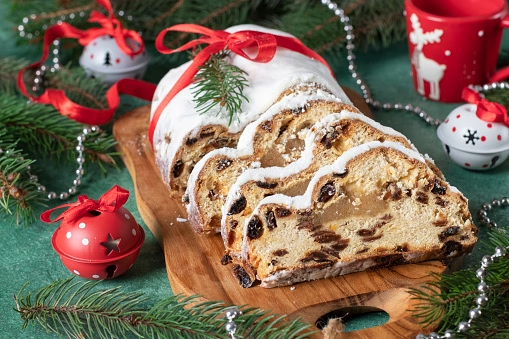
Katie’s Christmas Stollen
Ingredients:
· 1 cup whole milk, lukewarm (105 to 110 degrees F)
· 3 Tablespoons active dry yeast (this is slightly more than one packet)
· ½ cup sugar
· 4 cups all-purpose flour
· 1 large egg plus 2 egg yolks
· ¾ cup (1 & ½ sticks) unsalted butter, at soft room temperature
· 2 teaspoons pure vanilla extract
· ½ teaspoon almond extract
· Zest of 1 lemon
· 1 teaspoon salt
· ¾ teaspoon ground cardamom
· ¾ teaspoon ground nutmeg
· ½ teaspoon cinnamon
· 3 cups of an assortment of dried fruit, chopped. Candied citron is traditional but I prefer a mixture that could include dark raisins, pale raisins, currants, chopped apricots, chopped dried cherries, dried cranberries, dried maraschino cherries, and candied pineapple.)
· 1/3 cup rum (dark preferable but light is ok)
· ½ cup chopped, slivered, blanched almonds
For Glaze:
· 1 stick melted butter
· Powdered sugar
Instructions:
· Place all dried fruit in a bowl and pour the rum over the mixture. Let sit at least 1 hour or overnight.
· Heat the milk in a glass bowl in the microwave till just lukewarm (105 to 110 degrees Fahrenheit)
· Gently stir yeast + 2 tablespoons of the sugar into the milk. Let it sit for about 10 to 15 minutes until it is very frothy.
· In a large bowl, place flour, the rest of the sugar, egg and egg yolks, very soft butter, vanilla and almond extract, lemon zest, salt, and spices (cardamom, nutmeg, and cinnamon) and mix with a large spoon.
· Add the milk/yeast mixture and mix gently to moisten the flour. Knead the dough by hand or with a dough hook mixer for about 8 minutes until the dough is smooth and elastic.
· Scoop out of bowl, cleaning sides well. Lightly coat the sides of the bowl with oil and return the dough to the oiled bowl. Turn dough once to coat it with oil too. The doughball should now be smooth and roundish. Cover loosely with plastic wrap or a clean kitchen cloth and put it in a warm place without a draft. A slightly heated oven turned off is fine. Let rise for at least an hour until doubled in size.
· Punch the dough down. Pour off any unabsorbed rum from the fruit mixture. Add dried fruit mixture and almonds to the dough. Knead into the dough by hand or with a dough-hook mixer.
· Turn the dough onto a floured board and cut it into two equal halves. *(See special note below). Press and roll each section into a large, flat oval about 1 inch thick. Fold lengthwise, one-third of the dough toward and just beyond the center. Fold the other side over so it overlaps the first. The edge of the dough should be just past the center of the loaf thus created.
· Repeat with saved dough and form a second loaf.
· Placed formed loaves on parchment-lined baking sheet large enough so they don’t touch. Cover loosely with plastic wrap or a clean kitchen towel and place in a warm, draft-free spot or into a slightly warmed oven. Allow to rise for 45 to 60 minutes.
· Preheat oven to 350 degrees F. Carefully pick out any fruit that is sticking out of the loaf (it can burn during baking.)
· Bake the stollen for 30 to 40 minutes until golden.
· Remove from oven and let sit 5 minutes. Use a toothpick or wooden skewer to poke holes in the top of the crust. Brush liberally with melted butter. Dust loaves liberally with powdered sugar. Rub sugar into creases.
· Let the cake sit until it cools completely. When eaten at this point—delish!
· To store, wrap in plastic wrap or foil and leave to ripen in a cool place for up to 2 weeks. Or the loaves can be frozen.
*To make the Stollen extra special, add a surprise center of almond paste to each loaf.
For both cakes, you will need one 7 oz. roll (or better yet, 1 & ½ rolls) of almond paste. While the dough is rising, and before forming the loaf, roll the almond paste between your palms to form a long snake (don’t worry if it breaks). Center half of the “almond snake” on each of the rolled-out ovals of dough. Then fold the layers as described. The almond paste is an especially tasty surprise in each slice.
Sign up to receive the latest news, events and personal insights from Katie Lang‑Slattery.
Leave a Reply