
MY DAUGHTER ERIN AND I ARRIVED at Tokyo airport at 6:00 am on an overcast December morning. Two hours later, we met Yuki, our guide and driver for the next six days. He would become a friend who opened new windows into Japanese culture.
Tired but eager to immerse ourselves in Japan, we waited for him in the fourteenth-floor hotel lobby. A huge window wall offered a panoramic view across Tokyo. In the distance, a cell tower rose into the gray sky. At its foot, trees, tile roofs, and the glimpse of a multi-storied pagoda nestled among the surrounding rows of modern buildings and wide streets. Directly below our hotel, I watched the tops of cars slide by and the tiny figures of pedestrians cross the street. Shop fronts with colorful signs in unintelligible characters lined the road, and off to one side, the rusty color of a Torii gate caught my eye. I had not been to Japan for fifty years, and I could see the land was still a place of cultural contrasts.
When Yuki stepped out of the elevator, he greeted us with a twinkle in his eyes that I came to cherish. Tall for a Japanese man, he was dressed neatly, yet casually, in slacks and a khaki Columbia outdoor jacket lined with green fleece. His baseball cap covered a partially bald head, and his broad smile revealed a couple of missing molars.
During our three days in Tokyo, and later as we drove to Mount Fuji, this charming man explained the sights, offered basic Japanese history through his personal perspective, and shared tidbits from his life. We learned that as a young man he had worked in a fish market, and now the smell of raw fish was unappetizing to him. As a result, Yuki no longer ate sashimi, the iconic Japanese preparation of sliced raw fish. He told us about his grandmother, who had been a geisha, and showed us photos of the swords he inherited from his great-grandfather, who had been a samurai. And he answered Erin’s multitude of questions with a smile and often a joke, followed by a chuckle of appreciation for his own humor.
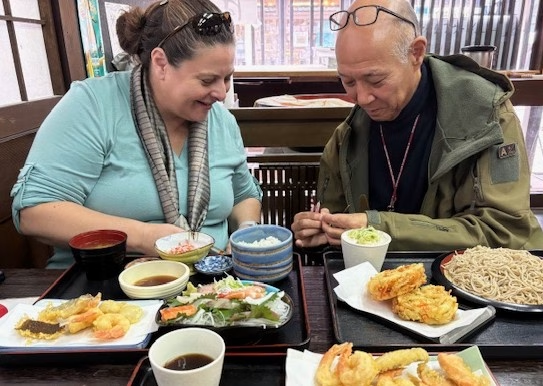
Near Mount Fuji, he took us to his favorite local restaurant. In a large tatami-matted room, we sat at a low table with a well-like space beneath to accommodate our Western legs. Following Yuki’s recommendation, we ordered the regional specialty. Outside, gray clouds hovered and threatened rain. The hot soup was comforting, and we eagerly ate the chunks of onion, winter squash, pork, and mushrooms swimming in a rich and flavorful broth. Best of all were the slippery lengths of wheat noodles. We slurped them up, imitating Yuki’s demonstration of how to enjoy noodles Japanese style.
The weather was biting cold on the December days we were with Yuki, and one morning he revealed that as a child he had been made to wear short pants in similar winter weather. “My grandfather told me that I was a boy and must be tough like my samurai ancestors,” he said. I shivered for him and was glad for my long underwear, sweater, coat, scarf, and gloves.
Yuki loved giving gifts. Most mornings, he brought us something—tiny, plastic sushi-shaped earrings, a packet of bath-salt cubes scented with lavender and lemon, kitty-themed coin purses, tiny origami cranes he had folded, and, once, a bottle of effervescent sake.
During the day, he often bought us snacks. He insisted we taste his favorite convenience store fried chicken and steamed pork-filled buns. One cold afternoon, he presented us with cans of the popular cream-of-corn drink he got from a nearby vending machine. Thick and warm, it tasted more like pureed corn soup than a drink, but it was a perfect snack on a day so busy we had missed lunch.
At a road stop on our way to Mount Fuji, Yuki bought us treats from the bakery there. Erin loved the round, fried bun filled with savory, curry-flavored minced meat, while my favorite was the melon bun centered with a soft filling that tasted like cantaloupe.
Most memorably, he shared his Shinto beliefs and introduced us to his hobby of collecting shrine stamps.
On our first afternoon together in Tokyo, we passed a Shinto shrine, and Yuki led us into the entrance area set back from the street. There he walked through and around a large straw ring suspended between two stone poles.
Erin, who loves all traditional things, was fascinated, and Yuki picked up on her interest. He taught her the ritual, showing her how to walk in a figure eight and when to bow toward the shrine altar. He told her this was meant to remove misfortune and cleanse the spirit. Averse to anything that resembles religious rites, I stood back to simply enjoy the ambiance and my daughter’s enthusiasm.
Together Erin and Yuki climbed the stairs to the sanctuary, clapped their hands to gain the attention of the gods, lowered their heads, and returned to the entrance where I waited. I tagged along as our guide led Erin to a gift kiosk. At the stand, he bought her a small, brocaded book into which a girl wearing a white kimono stamped some symbols and wrote with a calligraphy brush.
Later in the car, Yuki explained that collecting these special stamps at Shinto shrines was his hobby. “It’s popular with Japanese,” he said. “I have dozens of books of stamps I’ve collected over the years.”
Erin held her new book in her hands and stroked the silky cover. “I’d like to collect more,” she said. “Can you take us to more shrines?”
The next day, Yuki had his collection of shrine books in the car. Proudly he spread the pile of small, satin-covered books between the seats for Erin and me to look at. Out of courtesy, I began to thumb through one of them. The book opened backwards in the Japanese way, and the accordion-style pages presented beautiful compositions of stamps in red or black ink and the flowing strokes of graceful calligraphy. I was taken by their beauty.
These are art, not simply religious trivia, I realized. I picked up a second book and looked through it. Every page displayed exquisite Japanese works of art—each worthy of being framed.
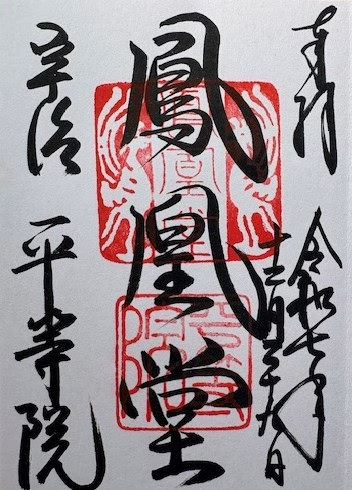
I leaned toward Erin across the back seat of the car. “At the next shrine, I want to get a book too,” I whispered. “I want to collect these stamps. They’re lovely.”
From then on, for the rest of our trip, we both collected stamps. I got my book at a shrine near Mount Fuji on another rainy afternoon. I chose a blue book, its brocade cover embellished with an image of the famous mountain, as well as other scattered symbols.
“If we are going to visit shrines,” Yuki said, “you need to understand something of the Shinto belief system, not just collect stamps.” He explained that Shintoism is the traditional and indigenous belief system of Japan. It values harmony, living in the present, the veneration of ancestors, family, and community. He told us that followers worship thousands of nature spirits, which are found in all things. He said the Shinto philosophy has no sacred text or strict rules to follow, yet it still exists as a basic moral compass for many Japanese, some of whom also practice Buddhism. “Buddhist temples offer stamps too,” he told us.
Our friend and guide taught us how to tell the difference between a Buddhist temple and a Shinto shrine. A shrine is easily recognized by its Torii gate, which always stands at the entrance. Inside the compound there are no effigies, though some shrines display a bronze mirror into which a worshipper can gaze and reflect upon their soul. Buddhist temples, Yuki explained, have no Torii gate and contain sculptures of the Buddha, as well as other effigies, perhaps of benefactors, patrons, or enlightened beings called Bodhisttva.
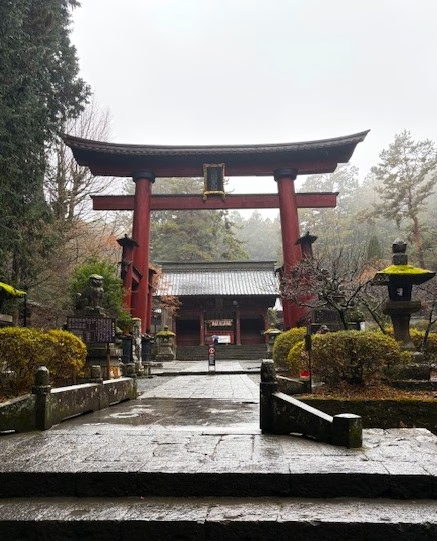
Both temples and shrines in Japan offer the calligraphy-enhanced stamps for a small fee, usually around two dollars. Erin and I were soon avid collectors.
Some shrines had such steep stairs that I could not easily climb them. Yuki would offer to take my book and get the stamps for me when he went up with Erin, allowing me to wait in some beautiful, sheltered spot below.
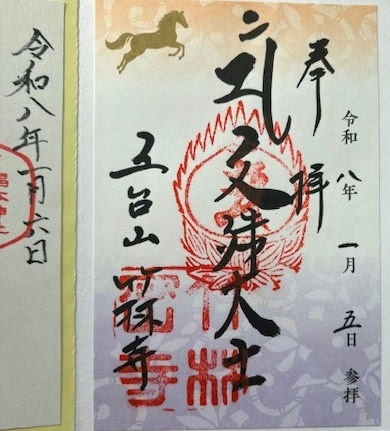
For the rest of our trip, Erin and I begged each subsequent guide to take us to any nearby site where we could get our books stamped, even if the places were not on our original itinerary. At some temples, the lines were long. The Japanese waited patiently for their stamp and the calligraphy written by a temple maiden or a monk. At the Byodoin Temple near Kyoto, our guide offered to stand in the stamp line while we visited the Phoenix Hall museum that held artifacts from the 10th century, including exquisite Bodhisattva statues and the temple’s original bronze bell.
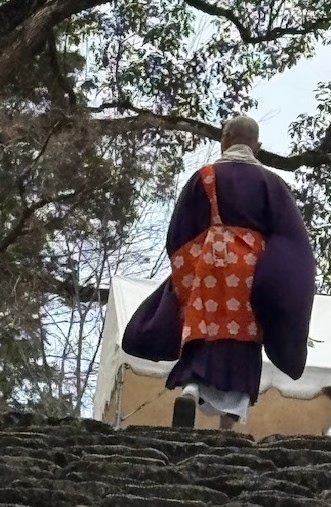
One day during the week we were on our own in Kochi Prefecture, we took a taxi and a winding bus ride to get another set of stamps at an out-of-the-way temple high on a hill. Once there, the beauty of the gardens and a room filled with golden Buddha statues enchanted us. Erin rang the bronze bell while I watched. Together, we ascended several flights of stairs edged by a garden of ancient trees. Ahead of us, a monk wearing a flowing purple Haori jacket climbed the steep stairs. The hem of his white kimono swished around his ankles as he hurried toward the pagoda atop the hill.
During our month in Japan, we collected a total of sixteen stamps from various temples and shrines. When I look at my book, I admire the artistic grace of the stamps and calligraphy, but more than that, I remember each shrine, each Torii gate, each temple with its golden Buddha statues. Most of all, I remember Yuki’s gap-toothed smile, his warm chuckle, the twinkle in his eyes, his gifts, and his friendship.

Sign up to receive the latest news, events and personal insights from Katie Lang‑Slattery.
Leave a Reply