
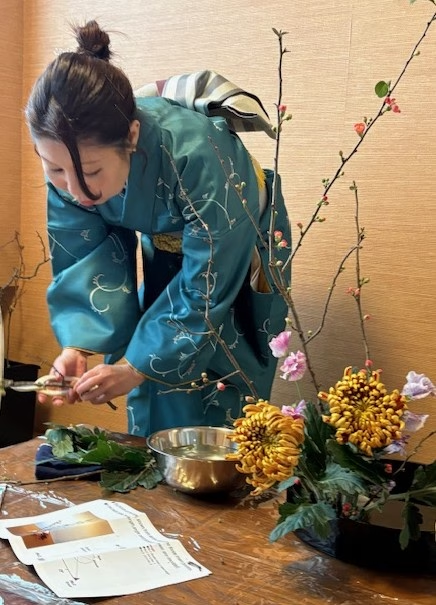
THE IKEBANA INSTRUCTOR, a tiny woman with hands no bigger than those of a ten-year-old girl, expertly flipped the dangling sleeves of her teal-blue kimono out of the way as she placed one branch studded with plum buds and three saucer-sized, gold chrysanthemums into a low bowl. Later, at a tea ceremony, we watched as the young instructor demonstrated the precise choreography of this ancient ritual. Each of her movements was studied, including keeping the long skirt of her peach-colored silk kimono tucked neatly under her knees.
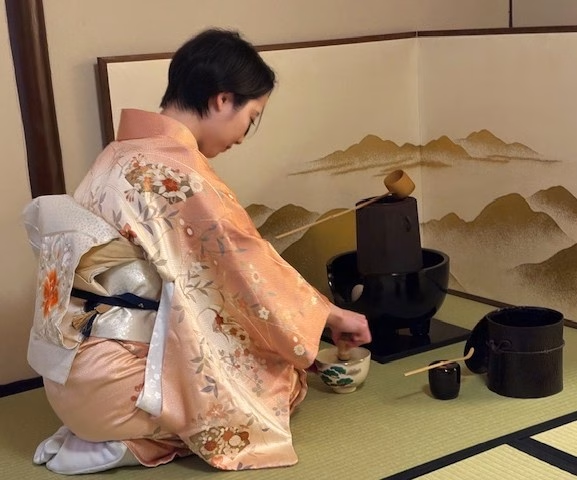
These young women were dressed for their jobs, teaching interested tourists about a Japanese art.
But during a recent trip to Japan, I never saw a Japanese woman wearing an everyday kimono on the street. Where had these iconic garments gone? Into cedar trunks, cupboards, or wrapped carefully in paper and stored in heirloom Tansu chests. Or on the racks in kimono rental shops.
Erin (my daughter and my travel companion) and I are both fascinated by traditional styles of dress, and we hoped to learn about kimono during our month in Japan. We soon realized that we would not see these lovely garments on women out shopping or riding the subway.
Two of our city guides were women, and each of them told us they treasured a few of their mother’s kimonos. They wore them on special family occasions such as anniversary parties or weddings. Mariko, our guide in Kyoto, was a lovely, typically petite woman of about fifty who dressed with style. Her short black hair was cut in an immaculate bob, and during our time together, she wore a soft, white woolen coat over her sweater and slacks. The early January days were frigid, and she completed her outfit with a fuzzy scarf wrapped around her neck and shoulders.
“I have a couple of my mother’s kimonos,” Mariko told us, “and one that belonged to my aunt.” Later she shared that she indulged in the expensive hobby of collecting vintage kimonos treasured for their beauty and rarity.
I was not surprised that women on the streets of Japan’s cities and towns today prefer to wear western styles. Teen girls and young women favor mini-skirts, perhaps pleated with high socks and thick-soled boots, or elaborate, frilly outfits worn with glittery high-heels. Long ankle-length, straight skirts may resemble the line of a kimono, but they are topped by bulky sweaters and worn with thick soled boots or sneakers. Girls may go totally occidental and dress in tight jeans, a sweater, a loose jacket, and often a scarf in the cold weather. Older women seem to prefer slacks, at least in winter when the weather can be frigid. According to Mariko few younger women even own a kimono, though they do still find it glamorous for special holidays and events.
Kimono rental shops make it easy for these women to celebrate special occasions without purchasing an expensive traditional garment along with all the needed accessories and undergarments. These shops are often found in areas where tourists visit as kimono-wearing is a popular activity for young people on vacation. Kimonos can be rented for several hours, half-a-day, or longer. Young Asian and Japanese tourists walk the nearby streets in their rented attire, take lots of photos, and generally enjoy the experience.
Erin, who has always loved costumes and dressing up, was eager to try wearing a kimono. The rental shop Mariko took us to was located on a street near several other rental shops. On the way to our destination, we passed dozens of kimono-clad young ladies and a few couples. For this romantic activity with their girlfriends, young men willingly dressed up in the traditional, formal outfit of a black kimono and haori jacket with full pleated, striped hakama trousers. The male ensemble was impressive, and I could sense their pride as the boys strutted in their outfits.
Inside the shop, row upon row of colorful kimonos hung on racks. After Erin selected a lavender flowered kimono, her attendant gathered up other items, and we followed her across a patio to a nearby building. Leaving our shoes at the doorway, we climbed to the second level and a large tatami-mat room with mirrors along one wall.
The dresser handed Erin a pair of the traditional, white cotton split-toed socks called tabi. “You need to put these on now,” she said. “It will be impossible to do it when you are in the full kimono.”
Once Erin stood in her underwear, the tabis on her feet, the dressing beganꟷone layer at a time.
First, next to her skin, special underwear. A long straight shift of light cotton, the first layer is designed to absorb perspiration and oils and thus protect the expensive fabric of the kimono. The dresser added a cotton pillow in the small of Erin’s back to camouflage her derriere.
“This will even out your curves,” the dresser told Erin as she tied the bulky pad in place. “Kimono demands a straight cylinder figure to look its best. No waist. No curves.”
Erin’s generous curves demanded a stiff panel tied firmly to her chest to flatten her breasts. I doubted most Japanese women need these bust flatteners and waist-filling pads, but shops must keep them on hand for curvaceous customers.
Next, the dresser helped Erin into a white, full-length under-kimono. She inserted acollar-stiffener (known as an erishin) into the neckband of the white kimono to add structure. She adjusted the neckline carefully, placing it away from Erin’s neck. She then tied a thin sash and a wider, stiff sash around Erin’s midriff to hold the under-kimono in place.
Finally, the dresser picked up the lavender kimono and slipped it over Erin’s shoulders, crossing the left front over the right side. “The way the kimono is wrapped is important,” the woman said. “It must be left over right. The other way, right over left is only for the dead in their coffins.”
Erin’s helper adjusted the collars of both layers, clipping them together temporarily. She tied a sash around Erin’s waist and smoothed out the fabric below, so the kimono lay flat across her hips and stomach. Next, she arranged the front opening into a precise V-shape leaving the edge of the white kimono visible. Another sash was tightened below Erin’s compressed bust to hold the front neckline in place. Now everything was smooth, top and bottom, with all surplus fabric and folds in the middle area soon to be concealed by the obi.
Erin stood with her arms raised while the helper wrapped the obi around and began to tie an elaborate bow in the back. Finally, a stiff board was inserted in front between the two obi layers, and the obi was secured with a scarf-like tie and decorative cord.
Well beyond dress-up age, I chose to watch rather than participate. Seated on a low stool, I was fascinated by the elaborate process from start to finish. I so wanted to take photos as the dresser dressed my daughter in the kimono, layer after layer. However, this was forbidden as another young lady was being dressed in the same room. A young Japanese girl with a slender, figure, she needed no extra padding to achieve the straight lines required for the perfect kimono look. She was finished, elegant and willowy, while Erin’s helper was still tying her obi.
When fully dressed, Erin was wrapped so tightly she was unable to bend at the waist. This explains why Japanese woman have perfected bowing from the hip and kneeling rather than bending to pick something up. Effectively hobbled, Erin walked in mincing steps to the adjoining hair salon.
Her thick hair was styled and adorned with the hair pins and loops of pearls she selected from a display. She was allowed to select a handbag and a fan and led us to an alcove where she posed while I took photos. I smiled to see the actress in my daughter emerge as she posed, turning and bowing, displaying her fan and the pearls in her hair. You can see for yourself how beautiful she looked.
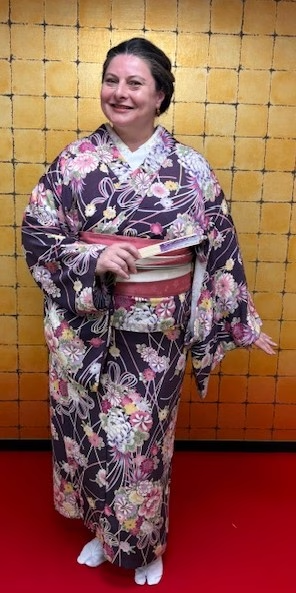
It was almost dusk when we went to the garden for more photos. Erin now wore outdoor platform sandals over her tabi socks. Her steps were small and careful as she proceeded to the street. I chose to wait in a nearby café and enjoy a cup of green tea, while she and our guide climbed the hill toward the temple, hoping for a few more photos in the fading light. Surrounded by dozens of kimono clad tourists on the narrow street, Erin was the only Western person―all the rest were Asian, though I could not tell if they were Japanese, Korean, or something else.
The entire “Kimono Experience” was a bit of a lark, though far too short-lived due to the shop’s imminent closing time.
Japanese ladies like Mariko who want a kimono or two in their personal wardrobe without breaking their budget can go to one of the many shops that sell pre-owned kimonos, yukatas (cotton summer kimonos), and Haori jackets designed to be worn over a kimono but also lovely over a dress or pants outfit. Accessories such as obis, handbags, tabis, decorative cords and jacket ties can also be purchased.
One afternoon in Kyoto, our driver took us to one of these shops. Without even going upstairs where the kimonos and obis were kept, we spent several hours happily looking at jackets. They came in hip-length and longer (about mid-thigh) and in so many colors and patterns it boggled the mindꟷeverything from formal black silk to bright flower patterns, from geometric designs to elegant slubby, shantung silk. Often, the lining of patterned silk was more beautiful than the outside of the jacket. The prices ranged from ten to well over fifty dollars. The clerks, two women and one man, pulled out jackets for us to try, one after another.
The store personnel knew the merchandise and told us the approximate age of a pieceꟷif it was from the 1980s or the 1950s or older. One of the women showed us a jacket with white basting stitches around the sleeves and collar. “This one was never worn,” she said. “See the stitches. They are still there from the seamstress who made it. The stitches are removed when it is first worn.”
Haori jackets have no buttonsꟷthey are closed in the center front simply by tying a pair of easily changeable cords. One of the jackets had frayed, uninteresting ties, and I asked if they carried extras to sell. The clerk opened a drawer filled with cords, including brand new ones with magnetic balls to hold them together . . . no tying needed.
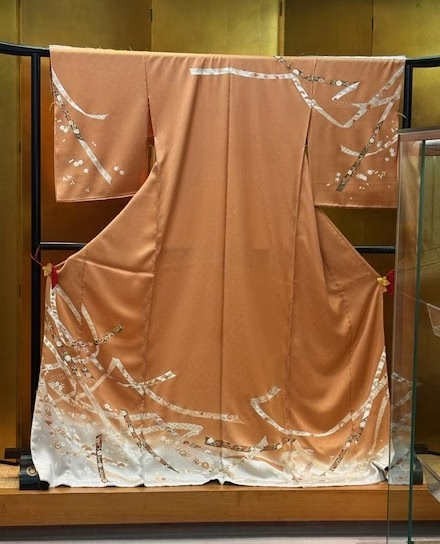
For wealthy women there are still a few shops that make custom kimonos to order for their exclusive clientele. We happened to pass one of these while strolling through a pedestrian shopping street in Hiroshima. Attracted by the beautiful kimono displayed in a street level window, I called Erin over.
The store itself was up a flight of stairs. “Let’s go up and see if we can get a peek,” I suggested. At the top of the steep stairs, glass doors and more display windows revealed an elegant space. The owner welcomed us in and graciously allowed us to take photographs. Along one wall, shelves filled with rolls of fabric waited for patrons to make their selections. A tatami matted platform with a beautiful kimono on display and a painted silk divider closed off the rear of the room. I imagined dressing rooms behind the screen and a seamstress kneeling as she measured a wealthy customer. Tasteful and luxurious at the same time, the shop was how I envisioned a Parisian atelier would be or a fashion boutique on Fifth Avenue in New York city.
A bit further along the same street, we saw a rack with white tabi socks. Behind the rack, in a narrow shop, a lady clerk dressed in a sedate gray kimono showed a roll of fabric to a customer. We realized this store was a less fancy and more affordable version of the boutique we were in moments earlier. Still, the young male clerk wore a black man’s kimono, as well as tabis and geta sandals―something we’d never seen on the street. He stepped forward and greeted us.
“I only want to buy a pair of tabis for a friend,” I told him.
He grinned. “No problem,” he said. “What size?”
Near the end of our stay in Japan, after several freezing days that included snow flurries, we woke to glorious sunshine. Erin and I decided to visit the Shukkeien garden to celebrate the warmer day. We sauntered along the twisting pathways of the miniaturized landscape, over arched bridges, around teahouses, past camellias, and under bare-branched maple trees. A long-necked crane preened his feathers near the central lake filled with rock islands.
Best of all, we glimpsed a romantic couple dressed in kimonos and posing for a professional photographer. I wondered what special occasion was being commemorated and my mind conjured an engagement or an imminent wedding. The young lady wore a lushly elegant, red kimono, her hair adorned with glittering pins. She held a paper parasol over her shoulder as she posed. Her companion, dressed in a man’s black and white, formal kimono outfit with wide stripped trousers, stood nearby. An older couple, also in traditional dress, waited on a bench in the shade of a pavilion. It was such a beautiful and unusual sight that I stealthily snapped a photo.
By luck, our last day in Hiroshima was Seijin-no-hi, or Coming of Age Day. This national holiday celebrates the transition into adulthood for girls turning twenty. Wearing fancy-dress kimonos is a traditional activity for girls on their special day. That afternoon, we saw two young women in full regalia―both dressed in pastel, flowered kimonos, hair adorned with ornaments, beautiful faces powdered, lips red, and carrying small, embroidered pursesꟷthe complete look as we saw it on the street of rental kimonos. The girls sat at a café sipping lattes from paper cups, their white-tabbied and sandaled feet close together as a kimono demands.
Though rarely seen and no longer everyday wear in twenty-first century Japan, the kimono can still be experienced. Luckily, the Japanese kimono has not totally disappeared.

Sign up to receive the latest news, events and personal insights from Katie Lang‑Slattery.
Leave a Reply