
CODED MESSAGES, SECRET DOCUMENTS, resistance fighters in the Polish forests, or camouflaged corpses as in the 2022 movie Operation Mincemeat—WWII anti-Nazi activities fascinate us. During a recent visit to the Wiener Holocaust Library in London, I discovered Tarnschriften, a special kind of anti-Nazi undertaking new to me. The word translates as “hidden writings,” and that is just what they are: reprints of speeches, manifestos, and essays in small print most often secreted within booklets claiming to offer everyday advice or advertising copy. Between 1933 and 1945, their goal was to inform and inspire dissent among the German populace suppressed by a Nazi autocracy.
The majority of these printed resistance materials, an estimated 80%, were produced by Communist organizations—the German Communist Party, the Comintern, and the Communist Party of the Soviet Union. Regardless of what one thinks of Communism, it is important to remember that in Germany under Hitler, though the Jews were the central ideological target, Communists were the main political target. The first victims of Nazi suppression and arrests, Communists were sent to linger and die in Dachau as early as March 1933. The Communists, with their widespread international connections, were able to maintain active opposition to fascism, even during the war.
The German Social Democratic Party, as well as Catholic organizations, also produced Tarnschriften. Close to 1000 different subversive documents were published, and up to 40,000 copies of some titles were printed. Universally, the hidden writings were anti-Nazi, and with the notable exception of a few issued by the far-right organization, The Black Front, they were also anti-Fascist. Many were produced outside of Germany, in countries such as Czechoslovakia and France, and smuggled into the Third Reich.
Messages ranged from anti-Nazi tirades to the texts of Socialist speeches, from how to build and use a short-wave radio to survival and resistance strategies, from information about the effects of bread or coal shortages to criticism against the ongoing war. Most texts were written anonymously, but some bravely listed their authors. A very few railed against the anti-Jewish Nuremburg Laws and, later, the murder of Jews in Eastern Europe. However, Tarnschriften concerned with antisemitism were rare.
Illegal resistance messages needed to be small and concealable. The publications were usually palm-sized, small enough to be slipped into a purse or pocket. The message or resistance information was often hidden behind an innocuous cover and sometimes embedded after several pages of non-political information.
The covers and other camouflage elements were carefully designed to target a particular audience who might be influenced by the inside message. Information about the Spanish Civil War meant to appeal to a youthful audience could be hidden inside a sports pamphlet. A working-class husband interested in growing cacti might discover a Communist manifesto inside his new botanical booklet.
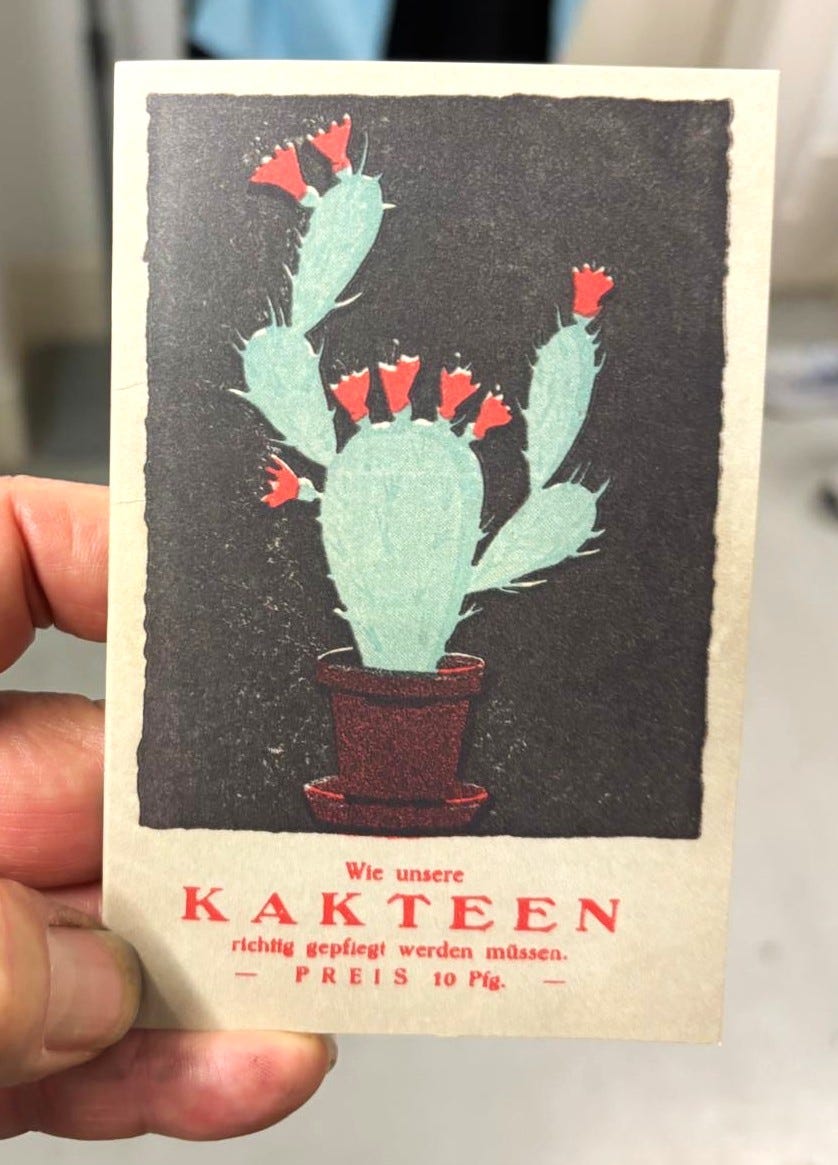
Besides being inside pamphlets, resistance writings were often hidden as tiny inserts within everyday objects such as garden seed packets or shampoo packaging. A woman, hoping for a cup of tea to sooth her nerves, might find not only tea leaves inside the packet but also a tiny booklet with a reprint of Thomas Mann’s banned commentary, “German Education.” Subversive writings were also sometimes inserted within the folds of standard pro-Nazi newspapers or magazines. It seems inconceivable to me how this was accomplished, but evidently, it was done. I imagine the job of slipping a subversive pamphlet into an edition of the rabid Nazi newspaper, Der Sturmer, would have been an extremely hazardous occupation.
The Wiener Holocaust Library currently houses a collection of 488 Tarnschriften, more than any place else except the German Federal Archives in Berlin. A few years ago, the library completed a massive project to digitalize their collection of these pamphlets so that they would be available online to people around the globe.
A visit to the pages of the library’s online catalogue reveals a vast variety of Tarnschriften, some with artistic covers, others very plain in appearance. Though all are in German, the catalogue listings include a brief note on the subject hidden behind their covers. With the help of my smartphone translate app, I was able to get an idea of the contents of some of the texts. Here are a few examples that represent the variety of the offerings.

56744 – 20 [zwanzig] Rezepte fur kostliches Backwerk
An early booklet published in 1934 masquerades as a cookbook titled “20 Recipes for Delicious Baked Goods.” A picture of a Bundt cake dominates the sepia cover. The first two pages offer actual recipes for several types of frosting, plus a King’s Cake, a Streusel Cake, and a “Blitz” Apple Strudel. On page four, the recipes disappear, and a long article on “new programs for social democracy explained by workers of the Social Democratic Party” follows. The final pages return to pastry recipes, though the total is far less than twenty.

20026 – Jiu-Jitsu
The thirty-six-page pamphlet, “Jiu-Jitsu,” hides an impressive list of essays behind a sports cover that shows two gym-suited men, their forearms locked in a classic martial arts pose. The essays inside, some of which list their authors, include “The Spanish People’s Struggle for Freedom” by A. Ackermann; “Anti-Fascist Work in the Forced Labor Camp of the Unemployed;” and “The Middle Class and the Struggle for the Popular Front” (a reprint from the Manchester Guardian, a liberal English newspaper of the time). Notably, this pamphlet was published in 1936 in Leipzig, a German city that at the time still sheltered a large Jewish community and had a conservative, anti-Nazi mayor.

56823 – Humor aus der Krankenstube
Some Tarnschriften were designed to appeal to the German sense of humor. “Humor from the Sickroom” published in 1937 starts with a few pages of jokes. The first one (as translated by Google) reads:
A carpenter and a doctor come to a village where a house is burning. The carpenter says to the doctor, ‘Look, my wheat is flowering.’ In the same breath he trips over a stone and breaks his leg. The doctor says, ‘Mine is already ripe.’
One must suppose that this joke is based on wordplay regarding wheat and maybe wealth that is funnier in the original German. After a page of such jokes, the real subject of the pamphlet emerges under a title that resonates with today’s politics, “The Rich Should Pay!” The piece begins with the line, “How long shall the people sacrifice and sacrifice?”

56793 – Zeiss-Ikon
In 1938, a powerful call to resistance was published under the guise of a camera manual. This small document is only three pages, including the cover, which shows a picture of a German camera. The first double-page spread contains another view of the camera plus text that extolls the features of the Zeiss-Ikon CONTAXII 35 mm camera. But turn the page, and a bold heading shouts, “Greetings, Dear Friends!” What follows is a proclamation against the Sudetenland crisis in miniscule print. With the help of Google Translate, I read the first few lines as:
The German people and the world have been thrown into the greatest unrest by Hitler’s surprise mobilization measures. Overnight, by secret decree of the Hitler government, 500,000 reservists received their conscription orders.
Whether this is true or its own form of propaganda, I do not know. After two pages of tiny, closely spaced text railing about the invasion of Czechoslovakia, the creators added a list of bolded slogans that include:
Down with the Warmonger Hitler!
We Do Not Want War!
Hands off Czechoslovakia!
From the outside, Tarnschriften appear innocent, but on the inside, they speak against Nazism and Fascism or for Socialism. During a time of strict book banning and media control, these underground documents were designed to inspire opposition to the government. They presented the German populace with a different point of view than the single-minded media propaganda from the Nazi party. Together they illustrate the power of the written word during times of censorship under an autocratic regime.
You can discover more of these fascinating treasures at:
https://wienerholocaustlibrary.org
Follow this link and click on Wiener Digital Collections. On the new page, enter Tarnschriften into the search bar.

Sign up to receive the latest news, events and personal insights from Katie Lang‑Slattery.
Leave a Reply