
GROWING UP IN THE 1950s, my older sister, Una, and I were among the few neighborhood children whose mother worked. Mother was a third-grade teacher. She ran our home like a big kids’ classroom, enforcing rules and doling out chores. By the weekend, she was tired of dealing with children, including her own.
To give herself a break, Mother made sure we were busy. As a result, Una and I were often thrown together for activities despite the five-year age difference and the fact that we seldom wanted to do the same thing.
Saturdays always started with housecleaning. Una, older and stronger, managed the vacuum cleaner, a loud and unwieldy machine. I was tasked with scouring the bathroom sinks, dusting, and ironing my father’s handkerchiefs. While we spiffed up the house, Mother happily puttered in the garden, trowel in hand.
Once the house was clean, the safest thing was to keep out of her sight. If we were any bother at all, Mother would surely find more chores. Una left the house in search of neighborhood friends, while I found a secluded spot to read or draw.
Our home was not a religious one, and Sunday was simply another weekend day for our mother to keep us busy and out of her way. I never knew if she needed time to grade papers or just a few more hours of childless solitude, but whatever it was, her solution was to take us to Sunday school.
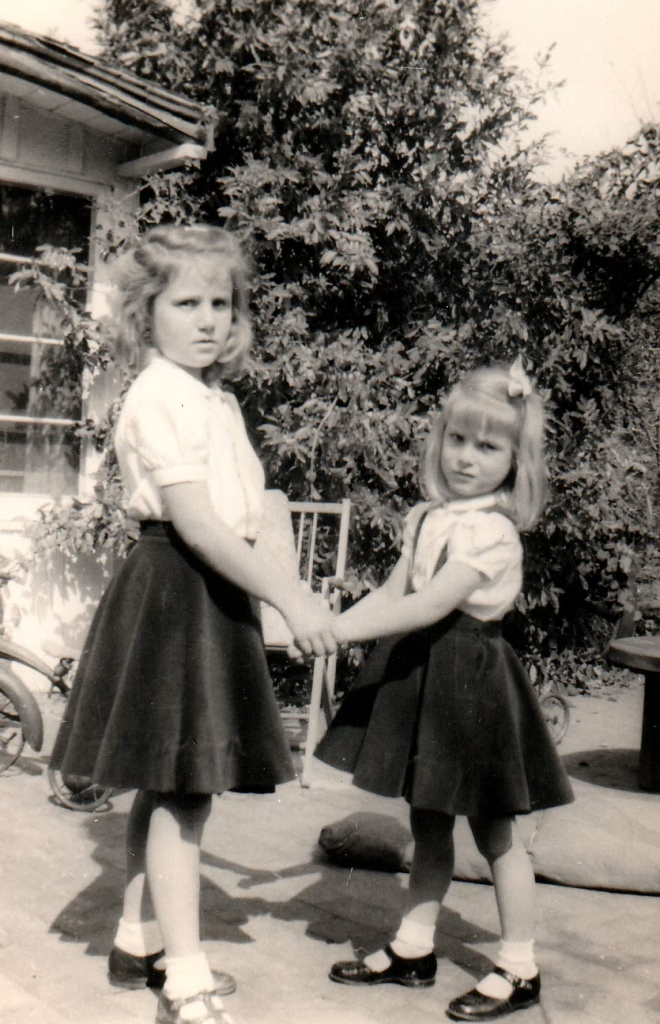
Una and I put on our best dresses, clean white socks, and patent leather shoes. Mother, clad in casual clothes, drove us to town and dropped us in front of the church. Her last words before she drove away were always a warning.
“Be standing on the sidewalk when I return. When Sunday School ends, you are to be the first ones out the door. If you keep me waiting, you’ll walk home.”
I loved these Sunday mornings. I liked getting dressed up. I adored the kind Sunday school teacher, and I enjoyed the stories of baby Moses and Jacob in his multicolored coat. Even Jesus and his fishes were interesting. But most of all, I loved coloring the Bible pictures we were given. At home, though I had lots of plain paper, crayons, and colored pencils, coloring books were not allowed. They did not foster creativity my parents believed—I must draw my own pictures. At Sunday School, I could immerse myself in the forbidden pleasure of staying in the lines and adding bright colors to the beautiful drawings of men in robes, shaggy camels, and the baby Jesus.
I don’t know what Una did in the classroom for older kids, but she seemed happy when she came out. Sometimes she even held my hand until Mother drove up. No matter how much fun Una and I had at Sunday School, we always ran as fast as we could to the street, afraid of making Mother wait.
One Sunday, the teacher told me my coloring was beautiful. I loved her so much at that moment, I forgot about my mother. I lingered in the classroom to help the teacher box up the crayons.
Una stood outside the door until I came out. She grabbed my hand, her grip tight and sweaty. “You’re late!” she said as she pulled me toward the street.
Mother was parked in the usual spot, the engine of our Ford station wagon idling loudly. Her back was straight and her face stern. She tapped her fingers against the steering wheel as we skidded to a stop near the car’s open window. Mother leaned over and spoke to us.
“I’ve warned you girls not to be late,” she said. “You kept me waiting, so now you will walk.” She waved her hand to indicate the way toward home. “Get going. The exercise will do you good.”
Even Una did not dare argue. She turned and headed down the street. I followed. We set one patent-leather foot in front of the other and started the six-mile walk toward home.
Hot tears slid down my cheeks when Una turned and pinched me rather than taking my hand. “It’s your fault we were late,” she muttered. “I hope your feet burn.” Then she strode ahead and walked just out of reach of my shorter stride.
As I trudged along, I was aware of the blue Ford trailing slowly a block behind. The purring of the motor and the blur of Mother’s face behind the windshield, though reassuring, were a constant reminder that we were in big trouble. I kicked at rocks on the side of the road until my Sunday shoes were coated in dust.
Finally, the side streets ended, and there was nowhere to go but Coast Highway. Ahead were miles of road with no sidewalk and lots of traffic. We would have to walk along the gravelly shoulder and around parked cars.
Una stood at the corner near the highway until I caught up with her. “Watch out!” She gripped my wrist and pulled.
Suddenly, the Ford was next to us. Mother stopped the car and rolled down the window.
“Get in,” she said.
Una yanked the door open, and we scrambled into the back seat.
“I hope you remember this,” Mother said. “If you are ever late again, you’ll walk all the way home … even on the highway.”
Una sat as far from me as she could sit. The car was filled with silence as we drove home. We were never late again. We knew Mother never threatened something she wasn’t willing to enforce.
Even so, I continued to love Sunday School and coloring pictures. After a few years, Mother got tired of driving us back and forth. By then, Una and I were both old enough to entertain ourselves and smart enough to stay out of her way on Sunday.
As a result of those Sunday school days, I earned two Bibles for good attendance. One was a regular Bible with a black leather cover and gold-edged pages, and the other, which I preferred, was a children’s version with words I could read myself and colorful illustrations. I treasured that book and kept it until I had a daughter of my own—a little girl who also loved stories and coloring pictures.

Sign up to receive the latest news, events and personal insights from Katie Lang‑Slattery.
Leave a Reply