
2024 continues
The next morning, Erin and I flew south to Madurai. Our new driver, Mooney, was an incredibly handsome young man clad in an immaculate white shirt and clean, pressed slacks. The seats in his SUV were encased in spotless white covers, and between the passenger seats he had placed a basket of snack-size bags of cookies and crackers. Large bottles of water nestled in each door pocket. Mooney certainly knew how to care for tourists.
The guide, Muntu, greeted us in accented English and draped garlands of yellow marigolds around our necks. Over the next fourteen days, these two were our almost constant, much appreciated, companions.
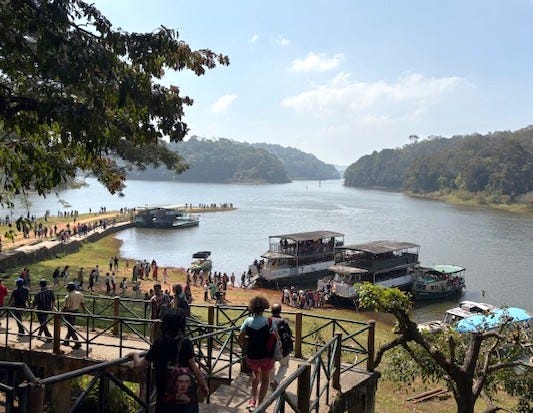
We spent two days in Madurai, then drove south and into the Cardamom Hills to see a tea museum and watch tea pickers, tour a spice plantation, and learn about elephants at a rescue station. At a national wildlife park on a lake, a place Tom and I had visited, I felt disoriented by how much it had changed.
In 1973, the lakeshore was deserted except for us, another van with Aussie travelers, and one black sedan with an Indian family. We waited all afternoon for the launch to take us out on the lake at dusk to watch elephants feed on the shore. Now, a parking lot was crowded with buses and cars, and a visitor center stood on a rise. Hundreds of people wound their way to the shore, formed queues, and climbed onto several double-decker boats that constantly plied the lake. The area was unrecognizable after almost fifty years of expanding tourism.
From the Cardamom Hills, Mooney drove us down a mountain road of continuous hairpin turns to the tropical coastal area of Kerala. There, Erin and I relaxed for a night on a luxurious houseboat where the staff of three served us a glorious meal. The next day, we toured the historic sights of Kochi, including the notable 450-year-old Jewish Synagogue. The old religious building had been closed to the public in 1973 and the surrounding area deserted. Now the same streets were crazy with tourists and lined with cafes and shops selling clothing and crafts.
Our trip coincided with the weeks surrounding Christmas and New Year’s, a holiday period that is prime time for overseas Indians to visit relatives. We saw few other pale faces, but every tourist spot was crowded with Indians from Australia, Britain, South Africa, America, Singapore, Malaysia, Canada, and Jamaica. They traveled in family groups, drove shiny cars, and spoke English in a polyglot of accents and intonations. This period was also pilgrimage season for local devotees. Groups of Hindu men, many with garlands around their necks and their foreheads adorned with devotional tilak (a man’s bindi), traveled from temple to temple, often by chartered bus.
Erin and I celebrated the first day of 2025 floating on backwater channels in a wooden boat propelled by a standing paddler. We sat in plastic chairs under an umbrella, watched silver fish leap out of the blue water, and imagined ourselves colonial memsahibs.
Of all our experiences, for me the highlight of the 2004 journey was the Ayurveda Spa in Munnar in the Cardamom Hills. Starting with the masseuse staying in the room to help me undress, everything about the treatment differed from a spa day in California.
Fully naked and wearing a flimsy paper loincloth the attendant had tied around me, I climbed onto the polished wooden treatment table topped with a thin, vinyl-covered pad. My young massage therapist applied liberal amounts of fragrant oil and began to rub my muscles. No part of my body was neglected. She kneaded and pounded my legs, my arms, my neck, my head, even my breasts and buttocks.
Once she was sure I was thoroughly oiled and relaxed, she began a hot herb treatment called Pinda Sweda. Assorted herbs were tied into a tight cloth bundle (a bolus), which she dipped in warm aromatic oil and used to pound and rub my legs, back, and shoulders. This treatment promised to relieve painful joints, though I can only verify that it felt divine.
Next came the house specialty―the oil drip treatment. With my head resting in a shallow basin carved in the wooden table, the therapist arranged a strip of cloth above my eyebrows and soft pads on my closed eyes. A strange apparatus, a cross between an oil lantern and a medical device, waited in the corner. I heard but could not see the young woman move this contraption into place over my head.
Soon I felt the warmth of a thin stream of oil flowing onto my forehead. My head was bathed in oil, and my hair became saturated. The liquid curved around the cloth, flowed down my cheeks, around my ears, into the basin, and out a drain hole. The ten-minute treatment cleared my sinuses and relaxed my thoughts.
Having been bathed in oil, I was now led to a wooden box and told to sit on the stool inside. Only my head stuck out. Fragrant steam puffed into the box and engulfed me. I dripped perspiration. By this time, I had given over all control to the young woman. When I was well steamed, she handed me out, rubbed my body vigorously with a rough towel, and then helped me to dress.
After all this pampering, the real world of congested streets, dust, and heat was jarring. I willingly put myself into the care of Muntu and Mooney, who took Erin and me back to our hotel for another evening of room service and soft beds.
*
I feel lucky to have visited India three times over the span of half a century‒each successive trip offered new experiences and revealed changes.
In 2001, improvements in infrastructure (roads, public transportation, and hotels) were evident. But I also saw families of displaced poor living on the new highway medians. Certainly a step up from the homeless sleeping on the concrete sidewalks I had witnessed in 1972, but also a sign of how far the country had yet to go.
By 2024, the prevalence of private cars, mostly sturdy new SUVs, and the disappearance of oxcarts clearly signified changes in wealth. In a weavers’ home, we saw a TV, a radio, a computer, and an Instant Pot, and we were told they had a WC with running water and a flush toilet.
Perhaps more than anything else, the changing nature of rubbish along the roadsides sticks in my memory. In 1972, litter was rarely seen. Trash was in rubbish piles regularly scavenged for useful bits and pieces. In 2001, I sometimes saw plastic bags blowing in the breeze, especially near homeless encampments. In 2024, litter along the roadside was endemic―plastic bags, food rubbish, and stuff like old shoes and soda bottles lined the city streets.
One afternoon on the most recent trip, after a long drive from the lowlands into the Cardamom Hills, we stopped on the dirt shoulder of the mountain road for a view of tea plantations undulating across the hills. As I snapped photos with my phone, I noticed our driver, Mooney, cleaning out the day’s accumulation of detritus from his immaculate car—cellophane snack bags, a paper sack with the remnants of fried breakfast snacks, and a banana peel. Mooney took everything and gently, almost reverently, laid it on the side of the road next to an empty water bottle and a tattered plastic bag. There was nothing casual about his action. I looked around. There were no trash containers anywhere in sight, yet many cars stopped nearby to enjoy the view.
I remembered a time fifty years before when Tom and I had stopped at a gas station in the mountains of Guatemala. I took a grocery sack filled with three days’ worth of carefully hoarded trash to the station attendant and asked in my rudimentary Spanish, “Basura?” The man accepted the bag from my arms and walked to the edge of a ravine at the back of the station. With a great heave, he threw my bag of trash into the gulley. I stood open-mouthed and aghast to see my rubbish added to the stream bed below, already cluttered with all manner of refuse.
Yet, in 2024, as we came down from the Cardamom Hills into the state of Kerala, the roadways were suddenly clean, there were strategically placed trash receptacles, and billboards reminded people, “Do Not Litter.” Muntu told us Kerala was the most prosperous state in India. Perhaps, I thought, the rest of India will soon follow their lead.
We left India through the gorgeous and modern International Airport in Cochin, a major port city in Kerala. A large billboard set among beautiful landscaping near the entrance proclaimed the airport to be the first fully solar-powered airport in the world.
Yet, despite the changes in wealth and the different levels of waste disposal, the essence of India seems eternal. Beggars, cows wandering the streets, the babble of many languages, elaborate temples, rich and spicy food, a complex history, heat, honking horns, bright flower garlands, smiling faces, and masses of people in flowing saris and dhotis—all of this remains part of the fabric of India.
Sign up to receive the latest news, events and personal insights from Katie Lang‑Slattery.
Leave a Reply