
Recently I read an article comparing ICE today with the German Sturmabteilung (SA) in the early years of Hitler’s Nazi government. (For the link, see below.) The content of the article was chilling, and I see the parallels clearly.
After reading the article, I wondered if my readers were fully aware of the role the SA played in the Third Reich. Most people have heard of the SS and the Gestapo, but, in my experience, few understand the power to cause harm that the Sturmabteilung Storm Troopers wielded during Hitler’s rise and the early years of Nazism in Germany.
In my novel, Immigrant Soldier, Storm Troopers drag away the hero’s relatives at dawn on November 10, 1938.
Well before that night, now known as Kristallnacht, Edith (one of the main characters in Ashes and Ruins) writes in her diary of her fear and loathing of the “Brownshirts.” In the flippant manner of a teenager, she calls the SA “an ugly organization.” When she is harassed by a glowering SA man in front of a Jewish department store, Edith taunts him but later realizes what she said was dangerous and could jeopardize her entire family.
So, who exactly were these SA Storm Troopers?
Officially known as the Sturmabteilung and often loosely called Storm Troopers or Brownshirts, the SA was a paramilitary organization established by Adolf Hitler and his Nazi Party in the 1920s. The colloquial name, Brownshirts (Braunhemden in German), began due to the color of their uniforms, which were designed to use surplus shirts originally ordered for colonial troops in East Africa during WWI.
Under the leadership of Ernst Röhm, the organization evolved and grew rapidly. It attracted disenfranchised young men (the majority under 30), the unemployed, and the working class, many of whom enjoyed action and violence. A willingness to see others as the cause of their problems was also a common trait of SA recruits, who could easily be persuaded to turn blame into hatred.
The violent Storm Troopers played a significant role in Hitler’s rise. As the “muscle” of the Nazi party, they provided crowd control at party rallies and intimidated and disrupted meetings of groups that opposed the Nazis. SA “soldiers” were known as thugs and street fighters who loved a skirmish with Communists, Social Democrats, gypsies, or trade unionists. Their specialty was harassing and beating Jews. In Ashes and Ruins, when Hugo comes home bruised and beaten, it was a gang of Brownshirt hooligans who had waylaid him.
By 1933, when Hitler came to power, the Sturmabteilung numbered at least 2,000,000—a frighteningly significant membership total, as it is twenty times the number of troops and officers who were in the whole German Army at the same time.
Their training was cursory at best. SA recruits learned tactics from training manuals and during weekend drills. They were taught hand-to-hand combat, how to wield a baton, goose-step marching, and crowd control. Armed with rubber truncheons, knives, police batons, brass knuckles, and firearms, they roamed the streets. With a swastika armband prominent on the sleeve of their brown uniform shirt and their jackboots shining, SA men spread fear among the population.
As the organization grew, the Storm Troopers continued their penchant for violence.
During the government-mandated boycott of Jewish businesses on April 1, 1933, members of the SA were in a celebratory mood. Many were assigned to stand in pairs in front of Jewish shops to warn prospective customers that if they entered, they would be written up as “Jew-lovers.” Others roamed the streets looking for Jews to taunt or physically attack, committing acts that exceeded those sanctioned by the boycott committee. In Frankfurt, Brownshirt thugs entered university buildings and forcefully expelled all Jewish professors and students. SA members in Berlin left their posts in front of Jewish establishments and marched en masse down the streets, shouting, “To hell with the Jews!” and singing the Horst Wessel party anthem. In northern Hesse, a group of a dozen SA men severely beat several Jewish innkeepers with truncheons. These were only a few of the acts of violence that were recorded at the time.
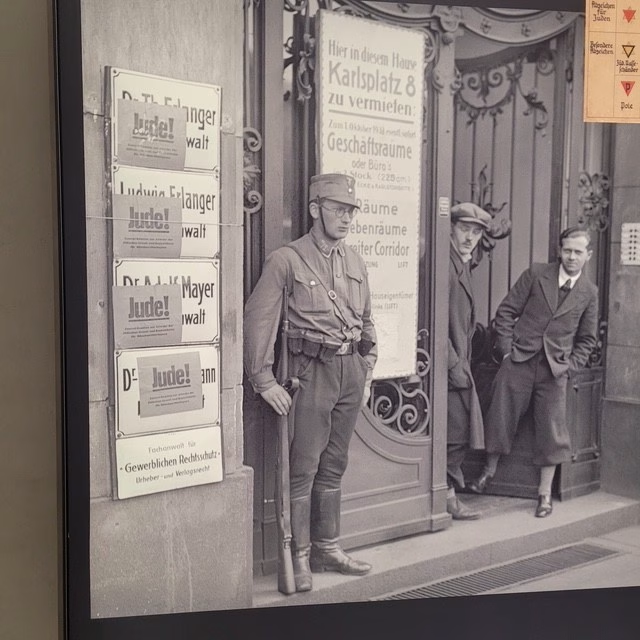
After the National Boycott, continuing unsanctioned violence perpetrated by the Sturmabteilung caused setbacks and difficulties for Hitler’s economic and international policy goals. The SA membership was far more socialist-leaning than mainstream Nazis. The Sturmabteilung leadership felt the “Nazi revolution” was unfinished and should continue until worker control and the destruction of capitalism were fully achieved.
Hitler’s goals were different. He wanted a racially pure, internationally powerful German state—all under his authoritarian rule. He had used socialist ideas only to attract the working-class masses to his cause. After a year in power, he preferred to maintain a capitalist foundation that would promote militarism, nationalism, and authoritarianism.
In the early summer of 1934, during a violent three-day purge originally called “Operation Hummingbird” but now known as the “Night of the Long Knives,” Hitler eradicated the radical factions of the Nazi party, including most of the leadership of the Sturmabteilung. Ernst Röhm, the head of the SA, was one of the hundreds murdered during the purge.
In the wake of the “Night of the Long Knives” and under new leadership, the SA organization was significantly downsized. Their mandated role changed to indoctrination and maintaining a strong Nazi presence in the everyday lives of Germans. To achieve these goals, the group trained military recruits, supervised youth groups, distributed and posted anti-Jewish signs, and scrawled graffiti. They continued to be known for street-level terror and intimidation, particularly against Jews.
In November 1938, the Storm Troopers were again at the center of violent mayhem when they led the government-sanctioned, anti-Jewish pogrom of Kristallnacht. (https://kathrynslattery.substack.com/p/remember-kristallnacht) They, along with many SS, arrested and imprisoned tens of thousands of Jewish men across Germany. Brownshirts invaded Jewish homes, beat the occupants, set synagogues on fire, held back firemen, and generally rampaged through streets across the country seeking Jews to assault.
In the aftermath of Kristallnacht, the Sturmabteilung lost its significance―supplanted as spreaders of fear by the SS and the Gestapo. (More about these other organizations in a future post). During the war, the primary duty of the SA organization shifted to training recruits in the armed forces. Most of the Sturmabteilung membership was absorbed into the army.
Between the mid-1920s and 1939, the Nazi Party used their SA Storm Troopers to terrify the opposition and build support through fear and coercion. But the role the Sturmabteilung enjoyed most was intimidating and physically abusing non-Aryans. To Jews who lived through the early years of the Third Reich ꟷ people like Clara and Edith in my novel Ashes and Ruins ꟷ the Brownshirts were never forgotten for their role in perpetrating anti-Jewish violence.
SA Storm Trooper tactics, like the methods used by ICE today, included beatings, intimidation, unconstitutional actions, and even murder. Drunk with their own power and the thrill of violence, the Sturmabteilung soon exceeded their authority and went beyond the role Hitler set for them. Dare we hope that a similar fate will come to ICE?
First published on kathrynslattery.substack.com on 02/07/2026
*Here is the link to the article by Robert Reich in which he shares the original article, “When History Starts to Rhyme,” by Neal McQueen.
Sign up to receive the latest news, events and personal insights from Katie Lang‑Slattery.
Leave a Reply